A new book by Alan Shimel
The Indispensability Trap
Why becoming essential caps the fortune,
from the railroads to AI.
Across every great innovation wave, one pattern repeats: the companies that build the essential infrastructure make the world possible, but rarely make the greatest wealth. From the railroads that connected a continent to the networks that power AI today, The Indispensability Trap reveals the hidden economics behind five eras that transformed our world.
With a foreword by Daniel Newman, CEO of The Futurum Group
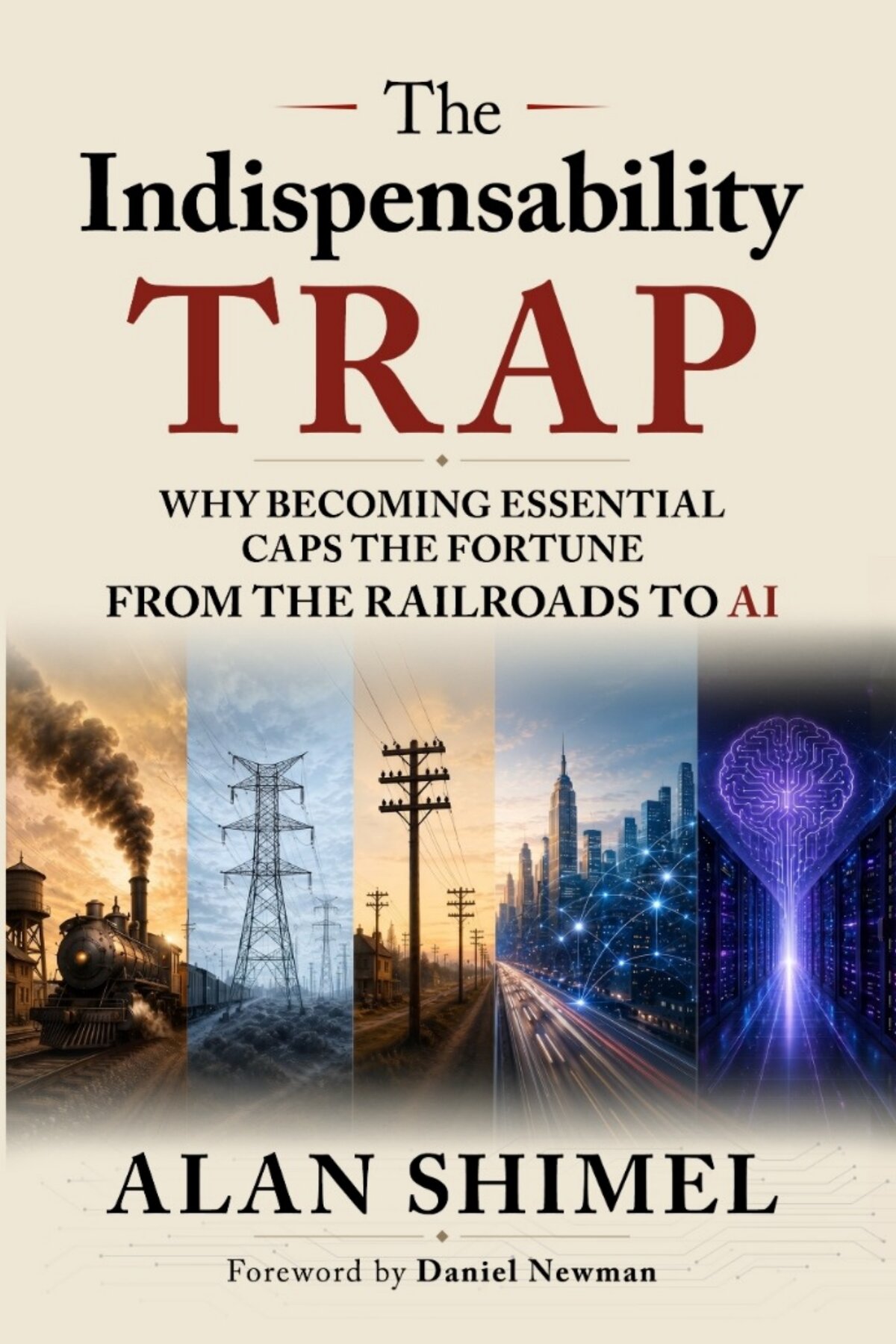
Hardcover · 328 pages · Fruition Harbor Press
- 01Railroads
- 02Electric Grid
- 03Telephone
- 04Fiber & Internet
- 05AI
Five great buildouts. One recurring pattern. The value always moves up the stack.
About the Book
A comparative history of American infrastructure — and where the money actually goes.
Meta is spending well over two hundred billion dollars on a single data center in Louisiana that will draw as much power as New York City yet promises only about five hundred permanent jobs. This is the fifth great infrastructure buildout in modern history, and the numbers dwarf the four that came before it.
Alan Shimel walks the reader through the railroads, the telephone, the electric grid, and the fiber-optic internet, and shows that durable wealth in each of these waves migrated up the stack, away from the people who owned the essential infrastructure. Then he turns the same lens on the seven companies now placing the biggest bets on AI, and asks the question every board and investor should be asking: which layer will hold value when the grid commoditizes?
Drawing on more than thirty years at the intersection of technology and business, and reporting from inside the last buildout he lived through, Shimel offers a defensible, source-locked account of a pattern most people building the AI economy have not read the history of.
“A must-read for leaders, investors, and entrepreneurs who want to build the companies, and capture the opportunities, that create lasting wealth in the age of AI.”
— from the jacket
Get the Book
Available in hardcover, paperback, and ebook.
- AmazonHardcover · Kindle
- Barnes & NobleHardcover · Nook
- Bookshop.orgSupport local booksellers
- Apple BooksEbook
- AudibleAudiobook
- Fruition Harbor PressDirect · signed copies
ISBN 979-8-9970373-0-7 · LCCN 2026920066 · Buy links are placeholders and can be swapped for live URLs before launch.
Inside the Book
Chapter by chapter.
-
The Trillion-Dollar Bet
In Richland Parish, Louisiana, Meta is spending well over two hundred billion dollars on Hyperion, a data center that will draw as much power as New York City yet promises only about five hundred permanent jobs. The fifth great infrastructure buildout dwarfs the four before it. The five-hundred-job figure sitting next to a hundreds-of-billions capital bill is the first clue that something in the standard story does not add up.
-
Grid and Appliance
Every foundational technology splits into two layers: a capital-hungry grid that gets built, and a value-capturing appliance layer built on top of it. Three recurring forces move the money from the first layer to the second. General Electric is honored as the model's hardest counter-case.
-
In the Railroad Business, Not the Transportation Business
Spring 1869, Promontory Summit. The transcontinental railroad is completed with a golden spike. Within twenty-five years a quarter of American railroad mileage sits in receivership. The wealth pooled in steel mills, oil companies, mail-order houses, packing plants, and the city of Chicago. The railroad men could not see that they were not selling track. They were selling distance.
-
The Monopoly That Asked to Be Regulated
Alexander Graham Bell's 1876 patent has been called the most valuable ever issued. Theodore Vail traded voluntary rate regulation for legally protected monopoly and used the resulting franchise to build the most magnificent cage in the history of business. Bell Labs and Western Electric produced so many world-defining innovations that the government eventually took most of them away.
-
The Man Who Asked to Be Regulated
The 1890 electrocution of William Kemmler, on an AC-powered chair Thomas Edison had secretly financed, opens the story of Samuel Insull, Edison's former secretary, who understood something Edison did not: electrification would be won by whoever could sell power cheaply and abundantly, not scarcely and dearly.
-
The Roads Were Already Built
The dot-com fiber glut, the collapse of bandwidth prices, and the wreckage of the ASP model become the backdrop for a chapter about what those roads actually enabled. The people who owned the pipes and racks and dark fiber mostly did not survive. The people who built on top of them quietly inherited the value.
-
The Fork in the Road
Goldman Sachs pegs cumulative AI infrastructure spending at roughly $7.6 trillion through 2031. The chapter maps the seven companies that have placed the biggest bets on which layer of the stack will hold value once the grid commoditizes.
-
Landlord, Tenant, Rival
On January 29, 2026, Microsoft loses $357 billion of market value in a single day. The chapter walks through the tangle of cloud contracts, model equity, and vendor financing that now ties the seven companies to one another as landlord, tenant, and rival simultaneously.
-
The Substrate
Trace any dollar from the circle back far enough and it arrives at TSMC, on an island a hundred miles off mainland China, and one machine maker in the Netherlands, ASML. National policy and corporate capex have merged.
-
The Free Model
On January 27, 2025, DeepSeek R1 wiped roughly $600 billion off Nvidia's market cap in a session. Model quality is converging faster than any forecast predicted while pricing collapses in near-lockstep. What has not commoditized yet is proprietary data, customer distribution, embedded workflow, and regulated position.
-
China's Two Loops
Two reinforcing loops: a digital loop in which Chinese labs seed the global developer ecosystem with free models and reap the improvements, and a physical loop in which the largest manufacturing base in the world generates real-world training data at a scale the United States cannot currently match.
-
Sovereign Ground
In spring 2026, OpenAI paused its planned Stargate UK data center and taught a G7 country that its AI infrastructure could not depend on decisions made in San Francisco. The chapter separates the word "sovereignty" into four distinct meanings.
-
The Switch
At 5:21 p.m. Eastern on June 12, 2026, Anthropic received a Commerce Department "is informed" letter and Claude Fable 5 went dark worldwide within hours. The state can now turn a model off at will, and every foreign national on Earth is inside the new perimeter of American export policy.
-
Where the Bets Land
Between May and June 2026, five companies that compete on nearly everything else independently converged on the same tactic: forward-deployed engineering, embedding their own staff inside customer operations, copying a Palantir playbook two decades old.
-
The AI Industrial Complex
In May 2026, Eric Schmidt got booed at the University of Arizona commencement. The chapter reaches for Eisenhower's 1961 warning about the military-industrial complex and updates it for a moment when the government has begun buying stakes in AI companies.
-
Who Bears the Cost
Water, land, and power that AI infrastructure consumes without paying the local price. Jobs that shift because AI capex crowds out other spending. Creators whose work trains the systems now competing with them. Four costs, four constituencies, one pattern.
-
The Strategic Capture
Governments across the world are taking equity stakes in AI companies, negotiating voluntary safety agreements that quietly extend export-control policy, and building institutional entanglement between financial success and regulatory oversight.
-
Safety Governance
Three fears actually running through public opinion about AI: job displacement, algorithmic surveillance, and the slow disappearance of human oversight in decisions that matter. The states are doing most of the actual governing.
-
The Grid Beneath the Cathedral
The book closes back in Richland Parish, where Hyperion is rising on land that once grew cotton, and asks its question one more time: when this much capital pours into a single buildout, who ends up holding the value it creates?
Sources & Further Reading
Every claim has a citation.
The book is source-locked: every date, figure, and attribution has been checked and, where verified, tightened. Public-facing bibliography and per-chapter source notes are collected here as a companion resource for readers, researchers, journalists, and policy staff who want to trace the argument back to primary material.
Part One
Meta Hyperion filings, Goldman Sachs capex analyses, historical share-of-GDP wealth comparisons for Vanderbilt, Carnegie, Rockefeller, and U.S. Steel.
Part Two
ICC records, AT&T 1906 bond sale, 1956 consent decree, Insull holding-company filings, dot-com era bandwidth-price and ASP-collapse reporting.
Part Three
Microsoft, Amazon, and Nvidia SEC filings; DeepSeek and Mistral open-weight releases; TSMC and ASML annual reports; UK, EU, India, and UAE sovereign-AI announcements; Commerce Department export-control letters.
Part Four & Conclusion
Spartanburg County land-use records, Abilene grid filings, NDAA preemption debates, state-legislature AI bill tracking, and public statements from OpenAI, Anthropic, Google, and xAI leadership.
Full bibliography and per-chapter source notes will be published here on launch day. To request the working bibliography in advance for review or reporting, use the contact form.

Alan Shimel
Author & CEO, Techstrong Group
News & Events
On the road with the book.
-
Fall 2026
Launch Week
Publication day, keynote conversations, and a launch event schedule to be announced. Add your email above to be first in line.
-
Ongoing
Techstrong Gang & Podcasts
Alan and co-hosts break down the week's tech news through the lens of the book's thesis on Techstrong.tv.
-
Coming Soon
Quantum, One Step at a Time
A new enterprise-facing podcast co-hosted with John Willis, extending the book's grid-and-appliance framework to the next infrastructure wave.
Contact
Press, speaking, and bulk orders.
Placeholder inboxes — swap in real addresses (or a form provider) before launch.